Pallet racks are standard equipment in many warehouses. When planning a new storage area or redesigning an existing hall, one question comes up early on: how many pallet positions fit into the available space, and how do the racks fit into the layout? With a simple construction kit for pallet racks, you can answer this question directly in the 3D layout – quickly and without manufacturer data.
The construction kit is part of the standard model library of the factory planning software visTable®. In this article, we show you step by step how to use it to dimension a pallet rack, design it in the layout and visualize it vividly.
The construction kit for pallet racks
Pallet racks are useful wherever material is stored on Euro pallets. They are typically designed as high-bay racks. The spacing of the upright frames is usually matched to the short side of the Euro pallet, so that standard pallets can easily be stored and retrieved. Creative solutions are possible as well: combined with roller tracks, the pallet rack becomes a flow rack, and gratings ensure that smaller goods on the lower levels remain easily accessible.
Especially in the concept phase, the exact configuration of such a storage system is still of secondary importance. What matters is thinking in rough variants and quickly turning planning ideas into a virtual model. A simple digital construction kit provides exactly this freedom: instead of manufacturer specifications, what counts is a quick three-dimensional design that you can try out in the virtual factory. This gives you a reliable indication of feasibility at an early stage.
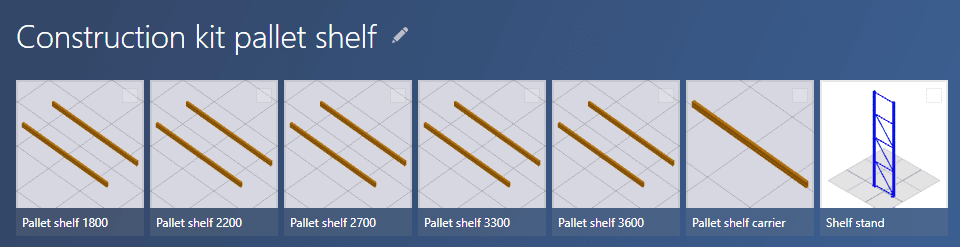
The construction kit is supplied with the standard model library of visTable®. It contains shelf stands (upright frames), preconfigured pallet shelves (beam pairs) in several standard lengths and a single pallet shelf carrier (beam) for special designs. You place the elements directly in the layout, just like any other object from the library.
What degrees of freedom are important?
Due to the pallet size of 1,200 × 800 mm, the grid of a pallet rack is relatively fixed, and so is its depth. The number of storage levels and the compartment height, on the other hand, must be variable. In addition, the equipment should leave some room for experimentation. For a simple construction kit, upright frames and preconfigured beam pairs are therefore sufficient.
Thinking from the inside out has also proven itself in warehouse design: first determine the required compartments and their dimensions based on the stored goods. Work with storage goods types – this keeps the planning flexible. Types can be defined, for example, by weight, dimensions or special requirements such as fire protection. Not every single item has to be known when designing the storage system.
For warehouse logistics, access frequencies play the main role. If you combine storage goods types with a classification of access frequency, you already have a sufficiently detailed basis for the design of the pallet rack.
Designing the rack grid
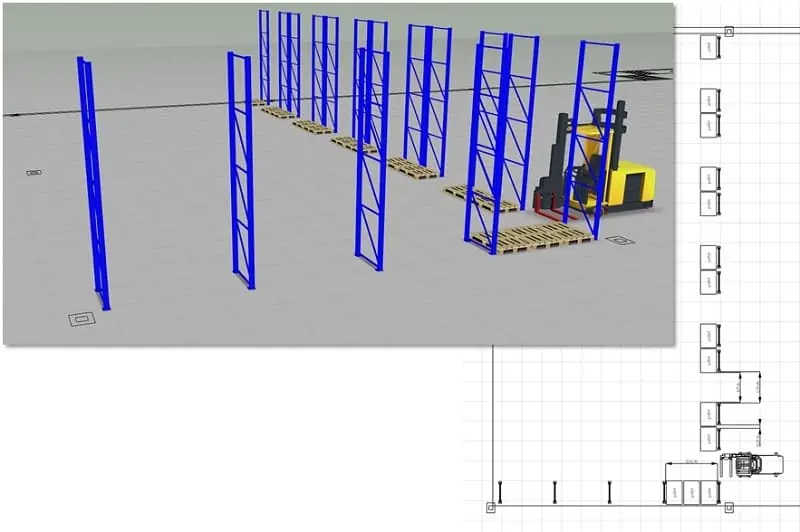
Once the pallet rack has been dimensioned, the design begins with the height of the upright frames. In the simplest case, all frames have the same height: you set one shelf stand from the construction kit to the right height and duplicate it several times. For high-bay racks, simply stack two frames on top of each other. With the Create array function of visTable®touch, this is done quickly and efficiently.
For the spacing of the frames, choose a standard grid so that complete storage positions are always created. Also note that stacker cranes and forklifts may require an overrun at the end of the aisle, which means that not the entire length of a rack aisle can be used for compartments. If in doubt, leave out one bay in the design rather than finding out later that the last bay is hardly usable.
Adding the shelf levels
Next come the shelf levels. The standard is one pair of beams per level. The construction kit contains beam pairs in several standard lengths for two, three or four pallets; a single beam is available for special designs. If you want to customize shelf levels, create your own variants in advance from elements of other catalogs in the model library: inclined roller track rails, for example, are included in the round tube catalog, and gratings can be found under building equipment. It is practical to combine these elements into modules. Standard modules can be welded in the visTable®ObjectManager – this way, you quickly build a customized kit of shelf levels that meets your requirements.
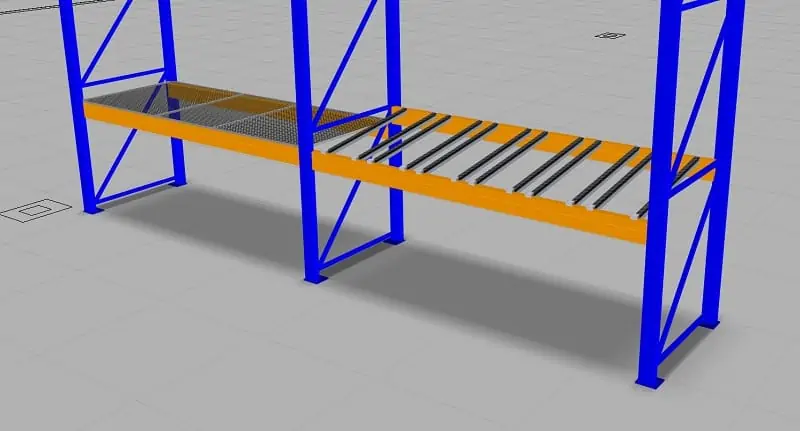
Finally, place the preconfigured shelf levels between the frames. Several identical levels can be created in one go using the Create array function. Compartment heights can be corrected afterwards to the centimeter using Lift/Lower in the 3D view.
3D stacking plans for pallet racks
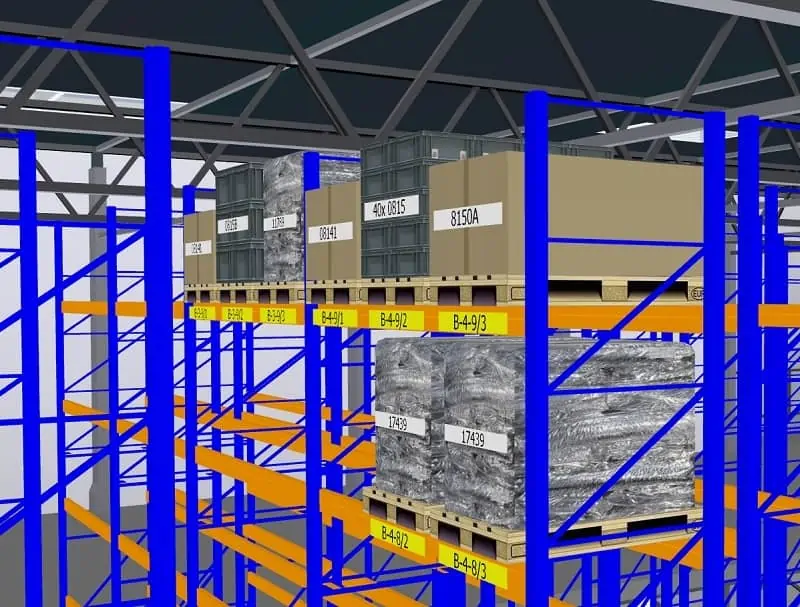
The finishing touch to a pallet rack design is a vivid visualization of the planned rack assignment. For this purpose, visTable® provides the Stacking plan catalog with various goods on Euro pallets, such as coils or cartons. The special feature: each of these models contains two label fields, one for the material number and one for the storage location. Via the equipment list, these details can be exported, edited in Excel, for example, and imported again. The result is a vivid three-dimensional stacking plan that brings the pallet rack from the construction kit – as well as any other rack in the visTable® warehouse layout – to life.
Conclusion
With the construction kit from the standard model library, you can create a pallet rack in the 3D layout in just a few steps: define the grid, place the upright frames, add the shelf levels and visualize the assignment with a stacking plan. This allows you to compare storage variants early on and coordinate them with everyone involved.
Which type of storage suits your requirements and what matters in rack layout and rack assignment is explained in our article How to integrate industrial racking into warehouse planning?