A Foundation for Efficient Processes
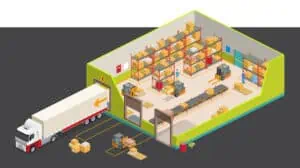
In every factory, materials, components, and products move continuously between warehousing, production, assembly, and shipping. It is precisely these movements that determine order lead time, operational costs, and the system’s adaptability to change. Effective material flow optimization does not merely address individual transport routes; it takes a holistic approach to transport operations, workflows, and storage structures. Increasing product variety, rising logistics demands, and growing space costs highlight the importance of a well-organized material flow. For planners and decision-makers, material flow optimization has become a central lever for aligning production and logistics systems sustainably while achieving measurable increases in efficiency.
Where Inefficiency Arises
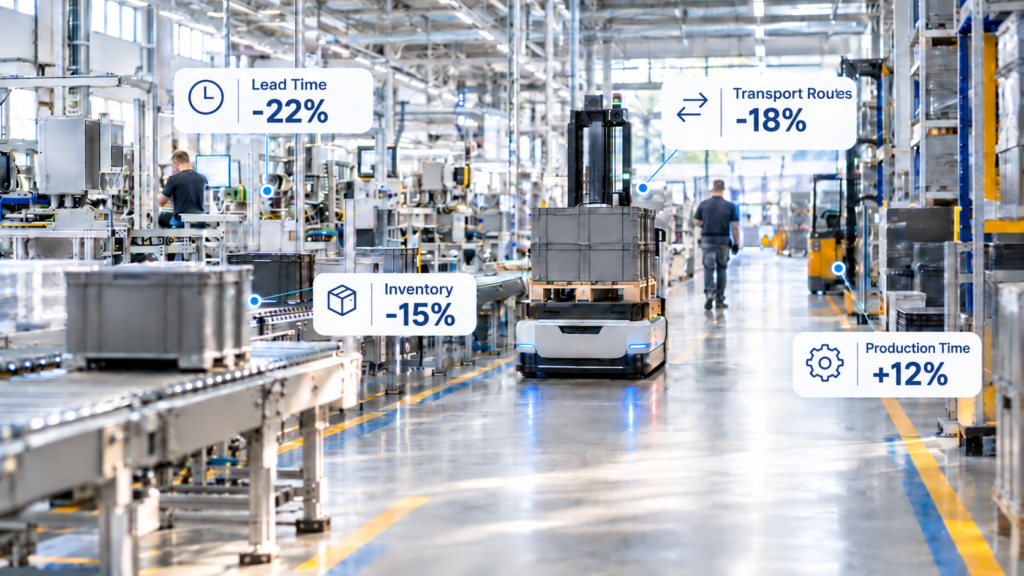
The goal of material flow optimization is to improve all material movements within the factory. This includes not only transport routes but also storage and buffer areas, process sequences, handover points, and the interface between production and logistics. Inefficiencies can occur in existing factories as well as in new construction projects. As factories grow, new assembly lines are integrated, or additional processes are introduced, requirements increase for space dimensioning, the implementation of new technologies, and the consideration of structural constraints. Three areas are often particularly affected: material supply, material movement, and material processing.
Unclear storage structures and a lack of inventory transparency lead to increased search and retrieval times, causing supply bottlenecks. In material movement, problems arise from insufficient transport equipment, intersections between pedestrian and material traffic, or heavily congested routes. Furthermore, workstation equipment influences the material flow, for instance, if materials are not provided ergonomically or in a process-oriented manner.
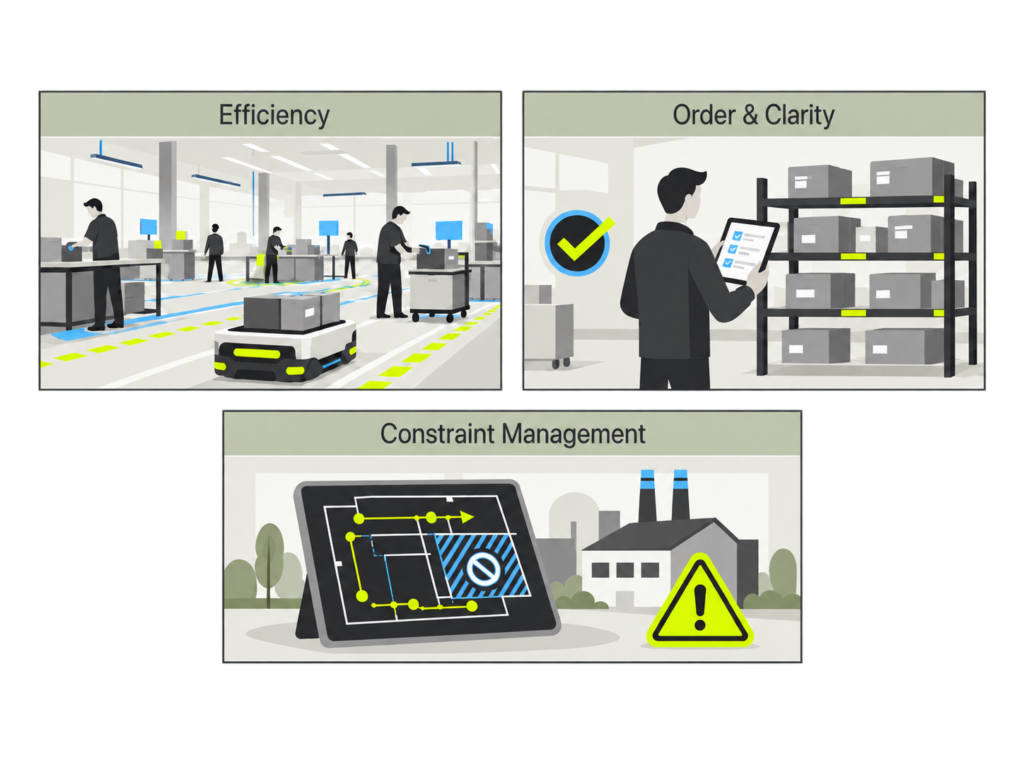
When machines or workstations are positioned without considering material flow, unnecessary transport, intersections, and bottlenecks arise. These factors directly impact key performance indicators (KPIs): excessive distances extend lead times, increase energy consumption, and tie up valuable resources. Oversized floor areas generate additional costs without adding value. Simultaneously, planning errors can increase ergonomic and safety-related risks, compromising both operational efficiency and workplace safety. This complexity escalates particularly during expansions, the integration of new technologies, or fluctuating production volumes. In such cases, existing structures must be optimized without disrupting ongoing operations. A challenge like this requires a systematic approach.
Systematic Planning as the Foundation for Increased Efficiency
The cornerstone of successful material flow optimization is laid during the layout planning phase. In this early stage, production areas, workstations, and storage zones are defined, and transport routes are mapped in relation to one another. Decisions made here significantly determine whether material flows will function clearly, seamlessly, and efficiently in the future. Even minor changes such as integrating a new assembly line or an additional workstation can impact routing and space requirements. If these interdependencies are not considered early on, subsequent corrections are often labor-intensive and involve substantial costs.
To achieve a sustainable increase in efficiency, key questions should be addressed during the planning phase:
- How large is the planned facility, and how can the available space be utilized effectively?
- What inventory levels will the plant operate with, and is there sufficient storage and buffer capacity?
- How are goods receipt and shipping organized to ensure materials are in the right place at the right time?
- Which legal, safety-related, or structural requirements must be met?
Material Flow Optimization as a Key Element in Factory Planning
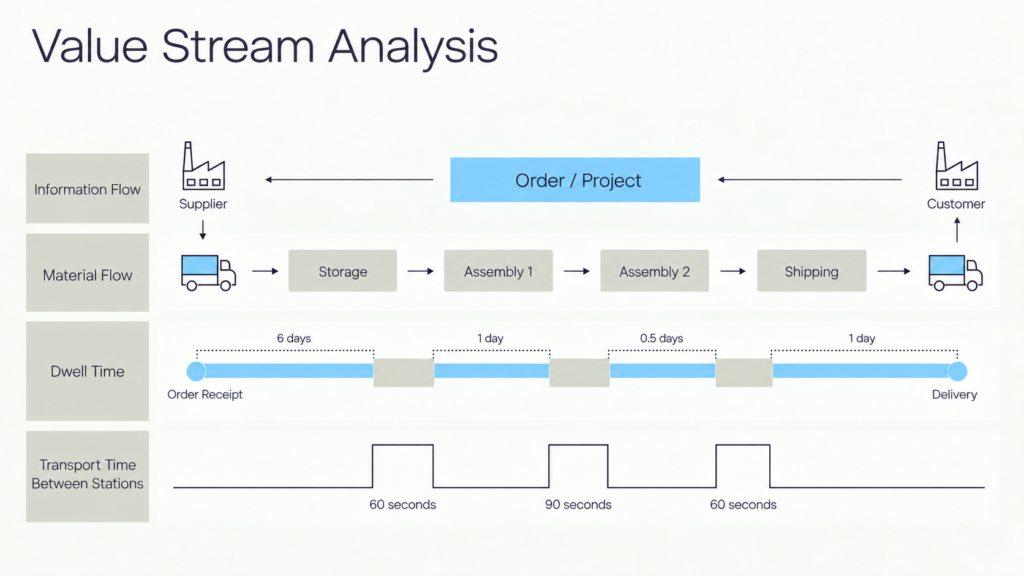
Various methods are available for the analysis and optimization of material flows, all of which require systematic and data-driven planning. A high-performance material flow forms the backbone of any productive factory and determines how smoothly materials move between processing, assembly, and warehousing. In practice, material flow optimization begins with the spatial arrangement of production areas. When goods receipt, manufacturing, and shipping are logically aligned, unnecessary handling and intersections can be avoided. The targeted use of automated transport systems or Automated Guided Vehicles (AGVs) can further contribute to stable and transparent processes. Methods such as value stream mapping or flowcharts make waste visible – for example, in the form of redundant transport or poorly utilized storage space. On this basis, material flows can be specifically improved and resources deployed more efficiently. Combined with Lean principles, processes can be standardized, inventories reduced, and the efficiency of the entire value chain increased.
Digital Support for Precision Planning
Given the multitude of influencing factors, manual and analog methods in factory planning quickly reach their limits. Digital factory planning software, such as visTable®, enables structured, transparent, and data-driven planning of layouts and material flows. With digital tools, layouts can be modeled realistically in 2D and 3D, material flows can be visualized, and KPIs can be leveraged for substantiated decisions. Layout variants can be systematically compared, space requirements precisely calculated, and restrictions considered at an early stage. This allows planners to identify optimization potential during early planning phases and avoid costly errors during implementation.
The result is a sustainable increase in efficiency throughout the entire planning process. Time and costs are reduced, while reliable foundations for decision-making are established – from initial rough planning to operational implementation on the shop floor. Material flow optimization and increased efficiency are not isolated tasks; they are central components of modern factory planning and the foundation for economical, flexible, and future-proof production structures.